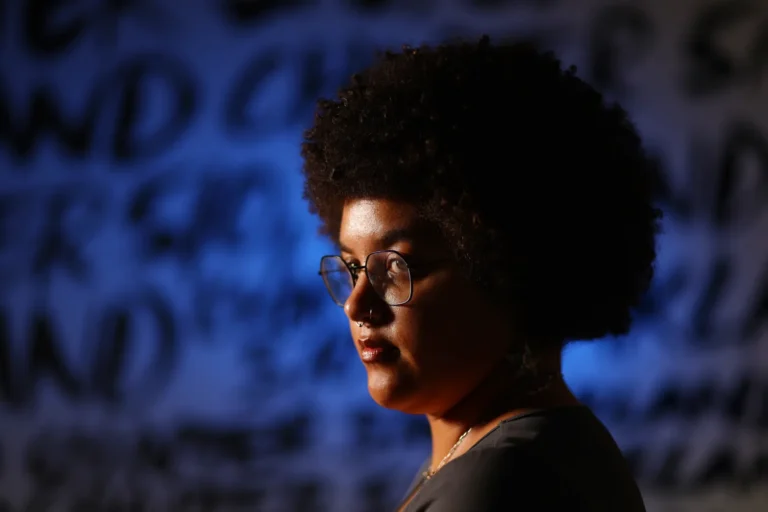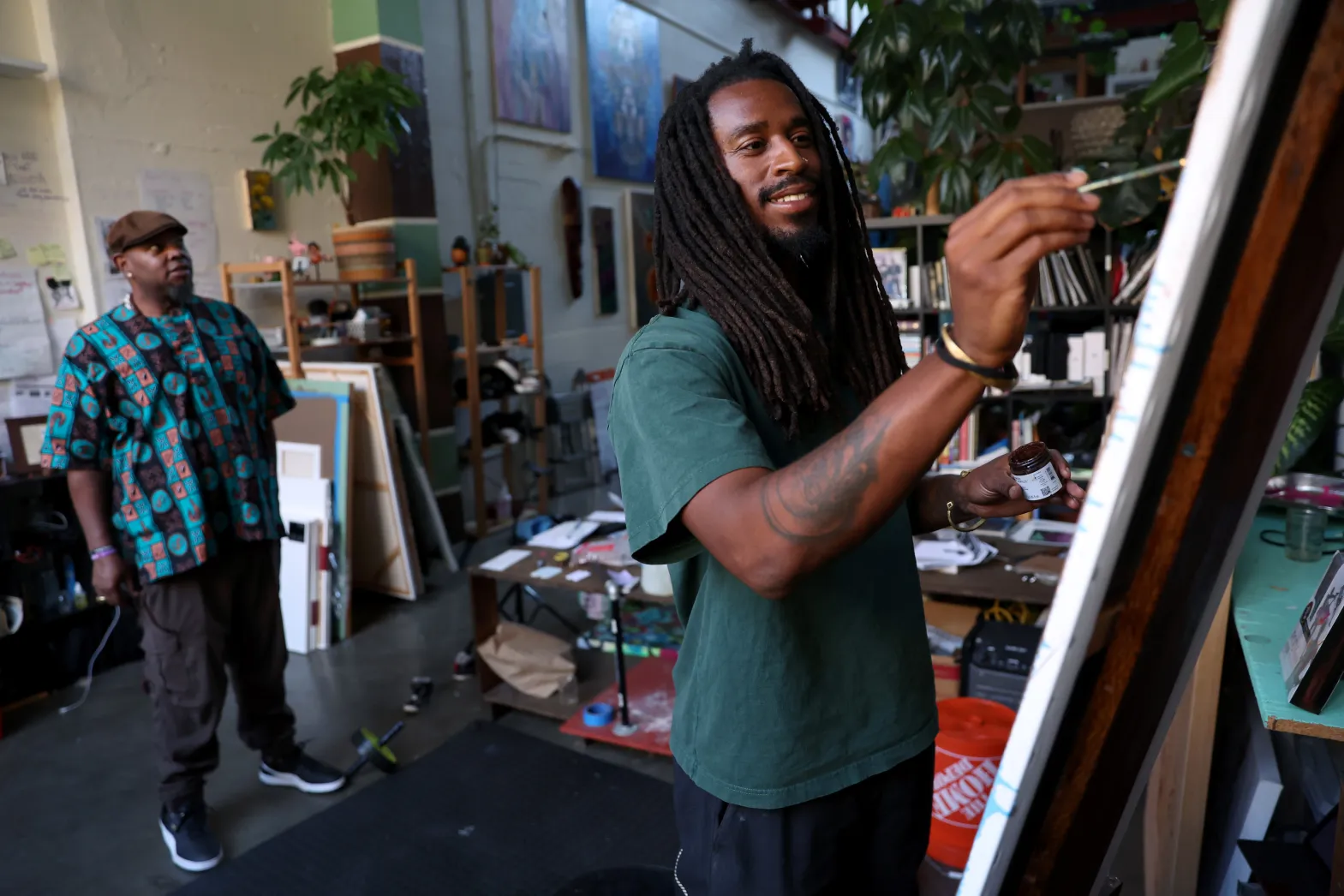

At 34, artist Timothy Bluitt has a portfolio of work that many would envy. His paintings don’t hang on walls, though. His work is the wall.
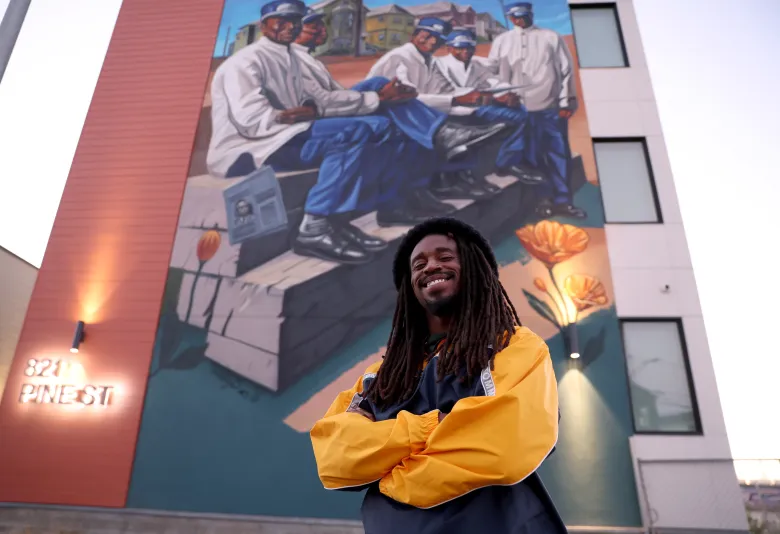
Bluitt, known professionally as Timothy B., is a muralist. His art adorns walls and fills space mostly in Oakland, and each one represents both his passion and the voices connected to Oakland civil rights legacy, history and honor.
“My style is a lot of Afrofuturism and history,” Bluitt says. “My goal is to celebrate Black culture, and a lot of that was inspired by my family.”
Bluitt is one of the success stories that has come from Indigenous House, an Oakland collective supported by the Omnira Institute. Indigenous House, until recently, was housed in Oakland’s Cannery, but it began more than a decade ago when educator Douglas Stewart began a series of programs to reach Black students in schools and expose them to history that many weren’t aware even existed.
The Omnira Institute, founded in 2003, has a mission “to support Black people’s emotional and mental health by preserving the roots of African American culture” through its chorus, community gatherings and programs, including Indigenous House. Stewart says Indigenous House is a way of connecting dots around tradition and cultural connections.
“Culture isn’t something preserved in a museum,” he says. “It’s something we practice, create and share.”
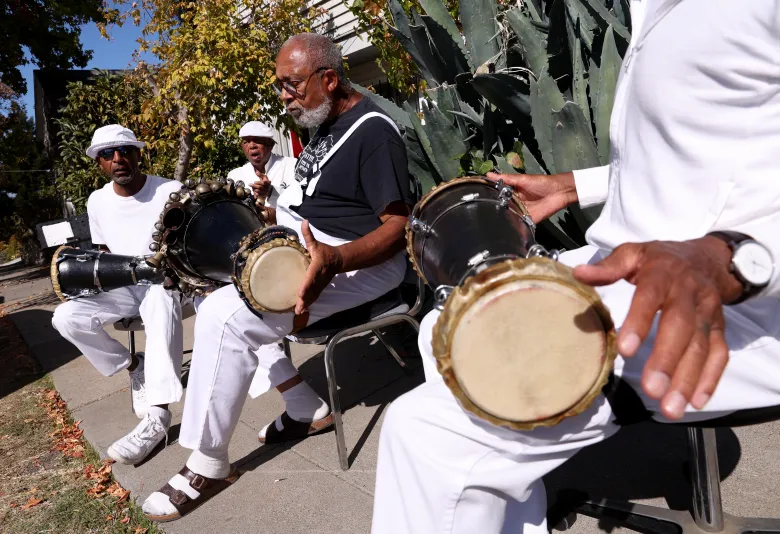
Part of that work includes programs called Sankofa and Living Room Sessions. Sankofa, Stewart says, is a West African term that means “to go back and fetch it.”
“We go back to our pasts and catch it, understand it and move forward in a positive life,” Stewart says.
The Living Room Sessions take that knowledge literally into living rooms around the Bay Area, and sometimes into businesses, reaching out to make connections and celebrate Black culture and understanding.
As a child, Stewart was inspired by his parents. His father was a NASA physicist and his mother, Stewart says, came from humble beginnings. They both recognized the importance of family and family history.
Stewart took that further, prowling libraries with his “gang of marauders,” who sought knowledge in sometimes obscure books and tomes. Even now, Stewart’s book collection could rival even the best-sourced libraries on Black history.
Never content to keep that knowledge to himself, Stewart has long sought to share it with others. One of those who has benefited from Stewart’s passion is Bluitt, his nephew.
Bluitt was raised by a single mother. He is a native of Fremont, but he grew up in Oakland and Stockton. Stewart was and remains a father figure to him.
Bluitt’s interest in the creative arts showed up early in his life. He did sketches, made videos and set his sights on tattooing. He also admired and studied the work of graffiti artists, which spurred him to take his art from small skin tattoos to multistory walls.
After taking some time off from college at Chabot, he began painting murals in Costa Rica and felt that was where his calling was. He learned to hear his own voice, he says, and to explore what it meant to be someone beyond the son of a single mom.
He returned to Oakland and moved into Indigenous House, which he says was “super encouraging.”
Bluitt’s career took a decidedly upward trajectory when EMPIRE, an independent record label based in San Francisco, commissioned him to create a memorial mural to the rapper XXXTentacion, who had been robbed and fatally shot in Florida in 2018.
“From that point on,” Bluitt says, “there has been no limits.”
Stewart is understandably a proud uncle and surrogate father, but he knows there are other young men and women who have the same potential and just need a little help and motivation to find it.
“We’re not trying to manufacture another Timothy B.,” Stewart says. “We’re trying to create the cultural grounding, mentorship, exposure and opportunity that allows the Timothy Bs already in our communities to emerge and become fully themselves.”
Earlier this year, Indigenous House lost its lease at the Cannery, and Stewart is actively searching for a new space.
“The Cannery wasn’t simply where I lived,” Stewart says. “My artist live-work loft served as a cultural hub, a place where artists, musicians, poets, educators, elders, young people, and community members gathered to exchange ideas, create, learn, perform, and experience culture. It was a living example of what Indigenous House was created to be.”
The vision for Indigenous House goes beyond just replacing the space, Stewart says. The larger goal is to establish the Indigenous House Cultural Arts and Wellness Center, a place where ancestral knowledge and contemporary creativity coexist.
“We’re exploring several possibilities,” Stewart says, “including a gallery, a multipurpose arts and cultural center, a larger live-work creative facility, and even farmland or a retreat property where we can bring together cultural education, the arts, nature, wellness, and community.”