
After Cheryl MacDonald was diagnosed with Parkinson’s disease 2 1/2 years ago, she started dancing again.
The longtime Lafayette resident joined the free Sunday afternoon Dance for Parkinson’s classes offered by Walnut Creek’s Diablo Ballet. She wasn’t just looking to have fun, as she had when studying ballet and tap as a kid or folk dancing as an adult. She was looking for a community where she could “just be me” and not have to explain her symptoms, which include stiffness in her left leg and in her facial muscles, which make it hard for her to smile.
As MacDonald got her body moving again to music, she also found relief from her symptoms. “Parkinson’s wants the body to get smaller,” she said. Brain cells that produce the neurotransmitter dopamine stop working or die, causing a potential range of neurological issues: tremors, slow body movements, balance problems, as well as changes to the voice and to speech. As the symptoms progress, people’s steps get smaller, she said. They also have less movement in their torsos, their voices get quieter and they have less facial movement, which is called facial masking. They want to isolate from others. “Our job is to fight that,” she said.
Dance classes for Parkinson’s disease have become a powerful weapon in that fight. While doctors have long recommended exercise for their Parkinson’s patients, decades of research have shown that dance classes are particularly useful for improving movement, balance, coordination, flexibility and cognition. Diablo Ballet began offering its hour-long classes in 2021.
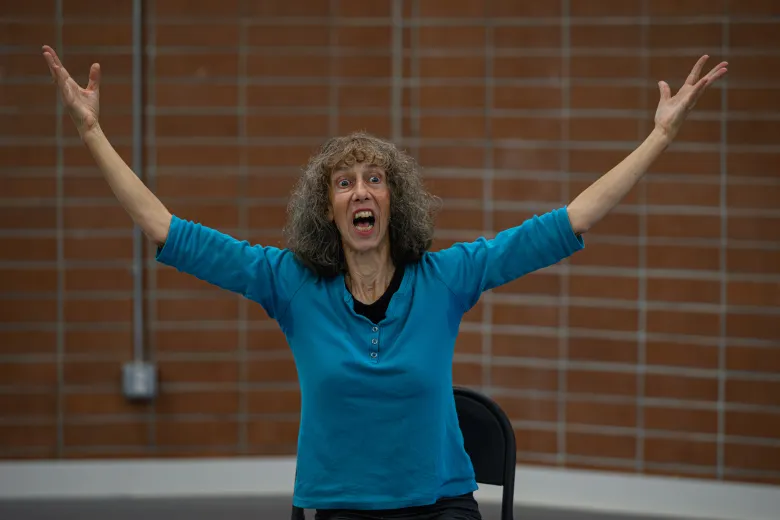
“I may come to the class feeling stiff, and without a lot of facial expression, but during the class I feel like a dancer and (I feel) happy,” said MacDonald, who also takes medication and does water aerobics. In dance class, she likes being encouraged “to go big, with big movements and facial expressions.”
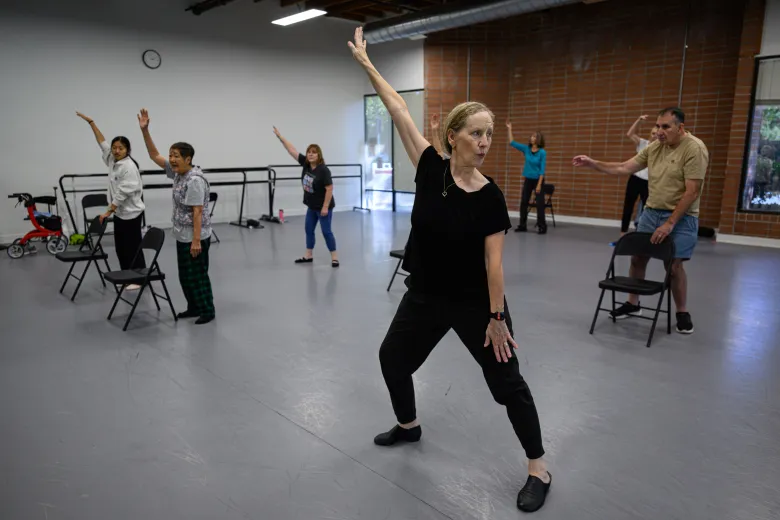
“I leave with a bounce in my step, and people have commented I have a more relaxed facial expression,” MacDonald said. “Exaggerated movements of all kinds are rewarded with less stiffness and greater flexibility. What a great way to loosen up by going big!”
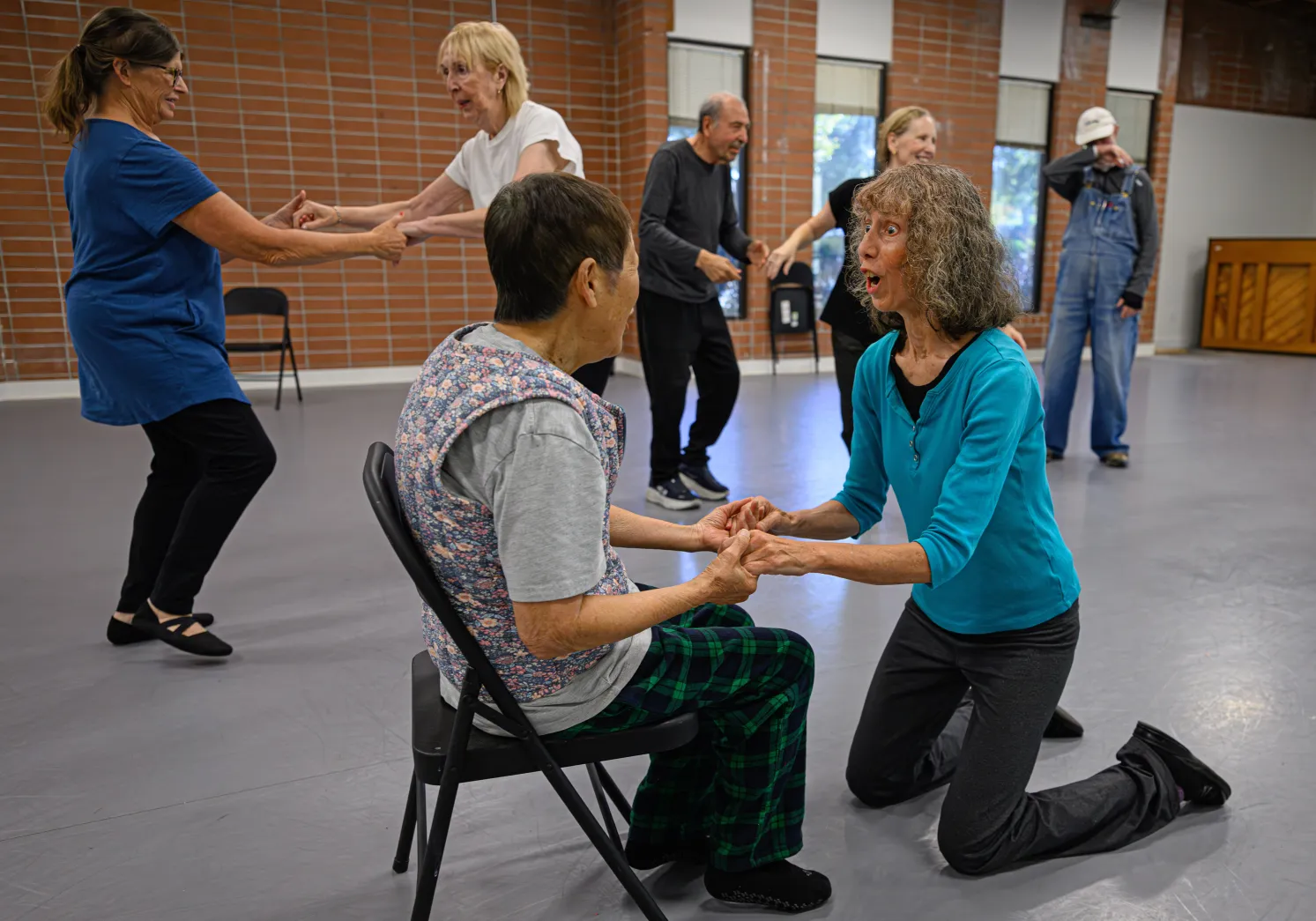
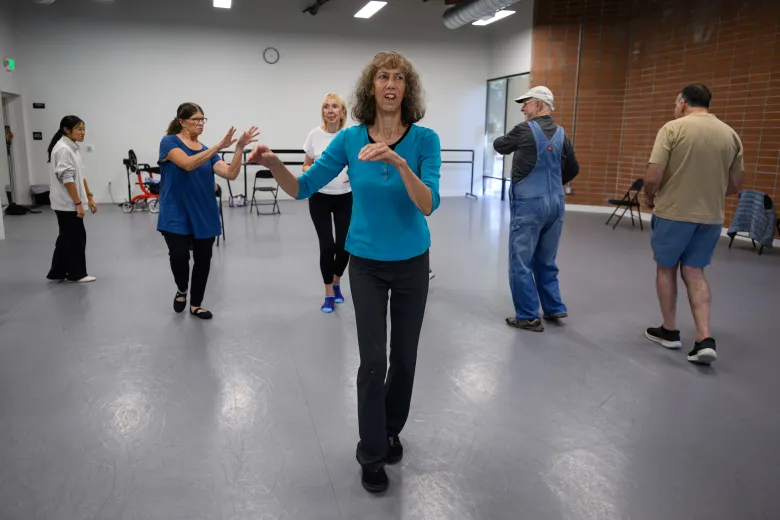
For her class that Sunday, MacDonald joined 10 other participants in one of the company’s mirrored classrooms. Of course, this was not a typical dance class. MacDonald and the others didn’t line up at the barre but started by sitting in chairs in a circle. Family, friends and caregivers also can join in and “be part of the community,” MacDonald said.
Andrea Gaudet, principal of the company’s ballet school, fired up “Cool Change,” an uplifting 1970s rock ballad and began taking the participants through choreography of both big and small movements of the arms, hands, legs and feet, some inspired by ballet and others by jazz, country or even a little hip-hop. Through song after song after song, Gaudet had students reaching, stretching, bending and swaying, as well as tapping their toes, rolling their shoulders or doing a rock-paper-scissors hand exercise for fine-motor skills. As MacDonald especially appreciates, Gaudet also told them to “open up your face” or to “stick out your tongue and smile big.”
It soon became palpable: This was a joy-filled space, where MacDonald and her classmates could let go to the music. There was a rousing, foot-stomping, finger-snapping rendition of Kenny Rogers’ “The Gambler,” and some sweeping, toreador-like arm moves during the Spanish Dance from “Swan Lake.”
The class ended with most everyone on their feet, forming a “Soul Train” line for Whitney Houston’s “I Wanna Dance With Somebody.” Gaudet invited everyone to do a quick solo of any move of their choice, with MacDonald step-bouncing her way down the line as her classmates cheered her on.
The classes follow the Dance for PD curriculum that was first established by the famed Brooklyn-based Mark Morris Dance Group in 2001 and has since expanded to other dance companies nationally and internationally, including the San Francisco Ballet. The curriculum is informed by ongoing research into how the combination of music and movement affects the workings of the brain, with Gaudet saying that dancing probably helps by getting the heart pumping and the neurotransmitters flowing, “bathing the brain in all those good chemicals.”
“The basic premise is that we’re leveraging and connecting parts of the brain to help detour around areas that are not firing so well,” said David Leventhal, a former Mark Morris Group dancer and founding teacher of the Dance for PD program. Just listening to music can be emotionally uplifting, while certain beats and favorite songs impel people to “get into the groove,” he said. Humans also have been dancing together for thousands of years, and moving in rhythm with others “is a very powerful connector,” he said.
The curriculum also grew out of the idea that dancers and dance teachers, as professional experts in movement, could help people with what’s classified as a movement disorder, Leventhal said. Dancers’ lives are spent training, rehearsing and mastering a range of physical and cognitive skills, such as turning, maintaining balance or performing complex sequences of movements. Dancers also need resilience and tenacity to get up and do “the same hard thing every day,” he said. “I think that’s often what people living with Parkinson’s have to deal with, like I have to get up and take care of myself as if I were a dancer or an athlete.”
For the 33-year-old Diablo Ballet, community outreach has long been a part of its mission. It also offers its Performing Arts Education & Enrichment for Kids, or PEEK, classes at 11 local Title I schools and Contra Costa County’s Juvenile Hall. This dance movement therapy program serves more than 600 underserved youth and 100 incarcerated teens throughout the year. Co-founder and artistic director Lauren Jonas said the Parkinson’s classes, which have reached up to 100 students and up to 25 every Sunday, likewise reflect the company’s belief that “dance is much more than an art form. It is a powerful way to connect with others, support well-being and enrich lives.”
During the class, Gaudet emphasized that students should only do what they feel safe doing, including whether they want to stand or remain sitting. Sometimes, students find they can do more than they thought, either because they have the group encouraging them or because the music is so propulsive.
During the Soul Train, Gaudet helped a woman who deals with episodes of “freezing of gait,” where she suddenly can’t move her feet, get up from her chair and take a few, wider-than-usual steps. “I just gave her a little rhythm, a little waltz step, a 1-2-3, 1-2-3,” Gaudet said. While it’s still not entirely known why doing steps in a rhythm may stop the freezing, it helped in this instance. Gaudet said she’s seen participants “cry tears of joy because they are able to move more than they have since being diagnosed.”
“That was amazing!” MacDonald said after seeing her classmate move in ways she had only read or heard about in webinars, leaving her determined to keep dancing to fight her Parkinson’s. “What a fun way to do it,” she said. “Big movements, fun music, great people.”